

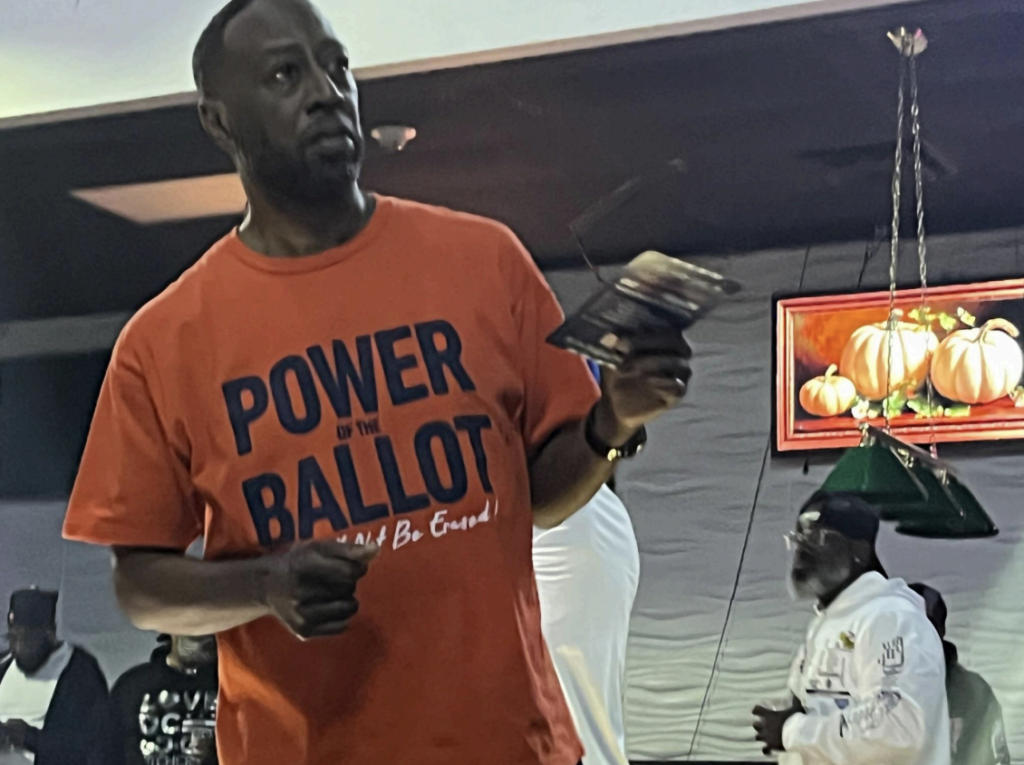
By Lilia Choice
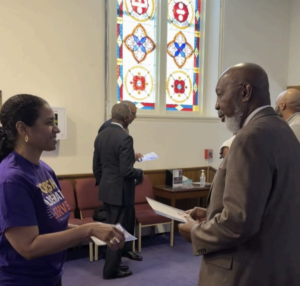
speaks with a church member after Sunday service at Metropolitan AME Church during a voter
registration effort on April 12, 2026. Photo by Lilia Choice.
WASHINGTON — Black faith leaders in the Washington, D.C., metropolitan area are mobilizing congregations ahead of upcoming local and congressional elections in an effort to turn faith into action and boost civic engagement.
“The role of faith is to hold the state accountable,” said Rev. Dr. Cassandra Gould. “When policies do more harm than good, we have a responsibility to help people build the power to change those conditions.”
More than six decades after the passage of the Voting Rights Act of 1965 and days after the U.S.
Supreme Court weakened key protections in the landmark law, Black faith leaders said it’s important to step up.
As battles over voting rights and election access unfold across the country and in Congress, they said they are adapting their efforts to meet the challenges posed by the political climate.
“The Black church is extremely active, even while it’s in a season of transition,” said Tony Lee, pastor of Community of Hope Church and social justice chair of the AME Second Episcopal District, adding that for “every generation, the role evolves because the struggle evolves.”
“We are sitting in a time period in which we’re fighting against Trump and white supremacy as it has re-emerged,” Lee said.
He pointed to what he described as a surge in attacks on marginalized communities following
the election of Barack Obama, the nation’s first Black president, arguing that progress has
been met with backlash.
To counter that backlash, Lee and other Black church leaders across the region are organizing
mayoral debates, voter registration drives, poll chaplain programs and protests.
The Community of Hope in Temple Hills, Maryland, is partnering with faith organizations to
deploy poll chaplains who help ensure voters feel safe. It is one of the church’s efforts to support
civic engagement.
“We have a very robust mobilizing and organizing strategy centered around voter registration, voter empowerment and voter education,” said Lee, who has also gone to nontraditional spaces like go-go clubs to urge crowds to vote.
At Metropolitan AME Church, an intergenerational Faith Action Committee was created to help the congregation become a “100% voting congregation.” The effort focuses on voter education, registration and turnout through workshops, candidate forums and community listening sessions.
“Our goal essentially was … ensuring every eligible voter within our congregation is registered and ready to vote,” said Joy Masha, co-lead of the Faith Action Committee.
Rev. William H. Lamar IV, pastor of Metropolitan AME Church, a historically Black church in downtown D.C., said, “churches are inherently political.”
“What one says about God and believes about the Creator shapes what one does in the world,” Lamar said.
Faith Leaders Face Challenges Mobilizing Communities
Faith leaders said they face many obstacles in trying to get people to be politically active.
By mobilizing underprivileged communities, leaders are challenging “institutions that are shaped to tear down our folks and tear down their hope,” said Lee. “We want people to live faithfully, but they’re living in hopeless situations.”
There are two types of organizing, according to Lamar: “Organized people vs. Organized Money.”
“When people have more money, you must outorganize them,’’ he said. “That’s what was done in abolition movements, civil rights, the women’s rights and gay rights movements.”
Lamar said it’s crucial to build relationships of power within communities.
“The demonstration of people’s power is a sacrifice we must make together,” he said, while also remaining gentle “with the realities of human existence.”
The Historical Political Role of the Black Church
Throughout history, Black churches have always been a site for “Black-centered political action and imagination,” said Jason Williams, associate professor of Social Justice Studies at Montclair University.
“The Black church has long been a center of both spiritual life and civic education,” according to Williams.
For example, early denominations like the African Methodist Episcopal Church (AME Church), founded by Richard Allen, were created in response to racism and quickly became spaces for organizing.
During slavery and legalized segregation, it was one of the few spaces where Black people could gather freely, share ideas and support one another, said Williams. He said it was a haven for enslaved Africans.
That role became more prominent during the Civil Rights Movement when leaders like Martin Luther King Jr. turned to churches to help organize protests and push for equal rights. But while some Black churches have been centers for advocacy, liberation, and progress, it is important not to hold a “romantic view” that every Black church was active, said Lamar.
“Either your church or religious institution has a politics of sustaining and strengthening the status quo or it has a politics of overturning the status quo in the interest of human beings,” he said.
Lee said Black churches continue to be a trusted space “where hope is embodied through community engagements and social justice.”
Williams agreed. “Religion and politics inevitably overlap because faith often shapes people’s values and values tend to shape public life,” he said.
Black religious leaders believe the church’s role is to unite people and guide them toward collective action.
“Politics is a way to figure out how resources are disseminated,” said Lee, adding that faith and policy are deeply connected. “The church has to be the moral compass of the nation, working to steer society toward policies that care for the marginalized and the downtrodden.”