

By Autumn Tinch

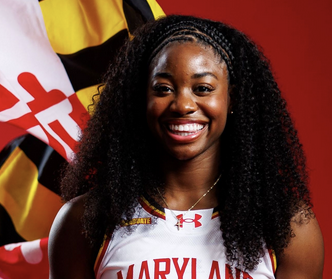
Mir McLean was fearless.
As a 5-foot-11 guard at the University of Virginia, she weaved through opponents with confidence to the hoop. At the height of her collegiate career at Virginia, she ranked second on the team in scoring and averaged 11 points per game.
But in 2023, as the clock counted down the third quarter in a game against North Carolina State University, McLean tore her ACL while coming down from a rebound. The crowd went silent as she lay on the floor in pain. McLean was later carried out on a stretcher.
The recovery process required weeks of physical therapy sessions and grueling practices. But for McLean, one of the hardest challenges was mental: Athletes are taught to measure themselves in numbers, times, stats and wins. After an injury, what happens when the goals of an athlete no longer reflect the needs of the recovering student?
“I always had the fear in the back of my mind of getting injured,” McLean said. “Before I was injured, a lot of my identity was wrapped around basketball and being an athlete.”
Nationally, 90% of collegiate athletes have reported they have been injured while playing in their respective sports, while 54% of athletes continue to play while being injured. The rate of return of athletes recovering from serious injuries, like McLean’s ACL reconstruction, ranges from 62% to 77%.
“What I find are the emotions that are really close to the grief process. So when we look at grief and we look at, there’s anger, there’s sadness, there’s disbelief, almost denial. We really see a swirl of emotions, which I think is what makes injuries so tough for athletes, because there are multiple emotions going on at once,” according to Ryan Defibaugh, LCPC, NCC, a licensed sports clinical counselor for MBS Performance Counseling in Baltimore.
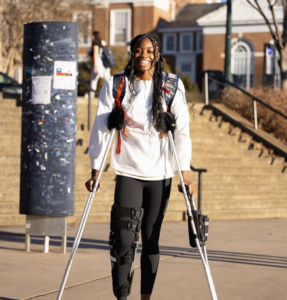
As McLean went through rehabilitation, at times reteaching herself how to walk, she learned to pace to her progress. “I was trying to take it day-by-day and not look too far ahead, because when I looked too far ahead, I got really sad that I wasn’t there yet,” McLean said.
Over time, McLean focused on rebuilding her confidence both physically and mentally. She created a structured, month-by-month plan to gradually regain her strength, focusing on one specific area at a time. “The first couple of weeks, we’d scheduled month by month. So the first month, we look at, okay, how can we get you, how can we get your quad to be stronger? So we would do quad strengthening workouts. It would be like lifting my leg over a foam roller or having weights on my ankles and trying to pick up the weights with my quad. McLean recalls.
McLean’s path included a significant decision: entering the transfer portal twice. The first time was driven by a simple desire to return to playing basketball, to develop her game and sharpen her basketball IQ. However, her second transfer came from a deeper, more personal place. “ I got really comfortable at the second school I transferred to, and it was somewhere where I couldn’t grow anymore,” McLean explains.
Seeking to challenge herself, McLean stepped out of her comfort zone, demonstrating her commitment to personal and professional growth that went beyond basketball.
“With basketball or just with any sport, there are progressions, and you can do some things; you can’t do all things. And it takes a toll on you mentally,” McLean said. “But once you get to the point where you’re okay to do whatever’s on the practice plan, all the fear is out the window.”
In 2024, from the stands in College Park, Mir looks the same -– same jersey, same posture, same smile, same quiet focus before the whistle. But watching closely, you begin to see it: the pause, the calculation and the weight of every play. The fear of returning to the court didn’t vanish in a single moment, McLean said; it faded gradually, losing its hold rep by rep, until it no longer dictated how she moved.
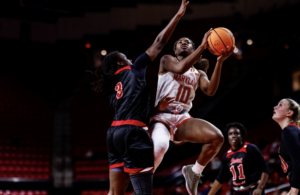
“All the fear is out the window,” McLean said. “With new movements and things like that, it was more of me just anticipating the contact and just trying to be more comfortable. After I got used to that, there were no more nerves.”
Athletes often view their injuries as part of their identities, “there are other moments where we start thinking about the implications of injury and missing out on a season or not contributing. or what I find is athletes, their self- identities, very caught up in their sport,” Defibaugh states.
Injury, often viewed as the worst-case scenario, quietly became a turning point for self-discovery.
McLean put it plainly: “I learned what it’s like to not be an athlete during my time when I was injured because I did learn a lot about myself, my interests. and things I like to do outside of basketball. It gave me more time to figure out who I am outside of the sport that I’ve been playing for a really long time.”