

By Njeri Kamenwa
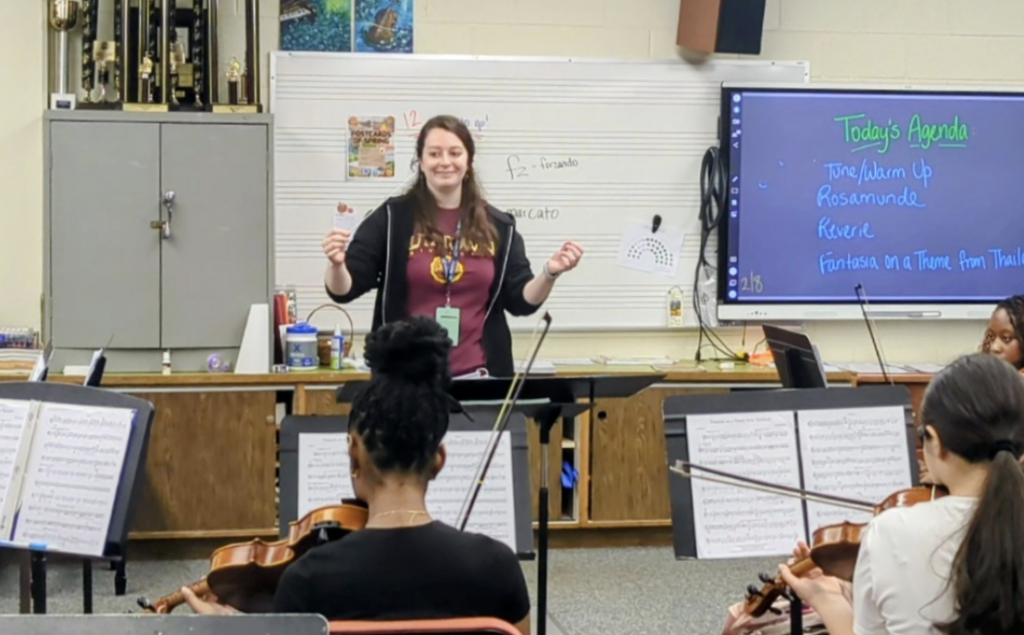
The 2025-2026 school year is wrapping up in Prince George’s County, Maryland, with students counting down the days until summer vacation and teachers making plans for next year. For Laura Keim—the new orchestra director at Eleanor Roosevelt High School (ERHS) who was introduced to students this time last year—the end of the school year is also a period of reflection for her as a first-time high school teacher.
“I’ve had to become a better conductor, that’s for sure. The music is harder, so I’ve had to practice my conducting way more so that I know how to cue people at the right time,” she says, sitting in her classroom.
“I’ve also had to adapt to the environment…there’s more consistency here, so I know what to expect from a day a little bit more, and I think that’s allowed me to be more organized and plan ahead a little better. ERHS doesn’t have an A-Day/B-Day schedule like middle school does, so the fact that it’s the same schedule every day helps with the consistency.”
Despite the challenges of working with more difficult music and in a more stable workplace, Keim enjoyed working with her new students and nurturing their creativity.
“It’s been a lot of fun and very busy. They are very motivated to play, learn, and participate in everything. They have a lot of ideas, and it’s been fun to capture and channel that energy, compared to what I was doing before,” she says of her students.
“Previously, I was trying to motivate, instead of trying to direct the motivation that was already there.”
Keim’s last role was teaching middle schoolers in Hyattsville, where, in her mind, much of their day consisted of “thinking about what they’re eating for lunch and where they’re going for field trips.”
By contrast, she noticed, the students at ERHS focus their energy on “adult-adjacent” problems, such as Advanced Placement (AP) classes—college-level courses that students can take in high school to earn college credit.
“I didn’t take a lot of AP classes in high school, so there are things that I’m like, ‘Oh, I didn’t even know that existed.’” Keim recalls.
Nonetheless, the average day for Keim looks the same across education levels.
“A lot of the day-to-day functions are the same, like tuning instruments,” she says. She also implemented new teaching techniques for the high schoolers that worked for her middle schoolers.
In the past, the ERHS orchestra was built on “trusting the process,” which did work in some cases. Now, Keim has the high schoolers record themselves playing excerpts of pieces on video and complete online practice journals. The videos are used to visually assess what the performer does correctly and what needs adjustment, while the practice journals help students reflect on their personal practice sessions and determine how they can improve as musicians.
These assignments switch back and forth every week: one week, the students will film a video, and the following week, they will fill out their practice journals. Because the music is so much harder in high school, learning proper technique is essential to “bring out the flavor,” as Keim tells her students.
So, what’s next for Keim? After experiencing a more consistent environment at ERHS, she knows how to plan better for next year. She hopes to “give students more opportunities to perform and express themselves” outside the classroom through community outreach and other events.
Keim’s emphasis on teaching technique and desire to have students apply what they’ve learned in the real world make her an excellent addition to the ERHS community.