By Sam Plo Kwia Collins Jr. and Tait Manning
Richard Wright, a Harlem Renaissance poet, author and essayist, fed his passion for writing as a teenager when he published his first story, titled “The Voodoo of Hell’s Half-Acre” in The Southern Register, a now-defunct Black-owned newspaper based in his home state of Mississippi.
More than a century later, as Black-owned publications and outlets navigate an increasingly digital, multifaceted news media landscape, young journalists like Jamari Tyree remain adamant about telling authentic stories about Black people and eventually launching an independent news venture.
Tyree, 18, has an opportunity to practice her craft at the D.C. public charter school named for Wright.
“It’s important to have that information out [and] Richard Wright Public Charter Schools (PCS) for Journalism and Media taught me.. how to write an article and determine what’s newsworthy while giving me a platform to publish my articles,” said Tyree, who’s currently in her senior year.
In 2021, at the height of the pandemic, Tyree counted among those who started their freshman year at Richard Wright PCS in a virtual academic setting. As she and others gradually made the return to in-person instruction, Tyree continued to explore her professional interests, writing about events and trends on her school campus.
She told The Informer that her portfolio currently includes stories about her experience at the Princeton Summer Journalism Program, Percy “Master P” Miller’s visit to Richard Wright PCS, and an honor that her school’s CEO Dr. Marco Clark received when he accumulated 100 community service hours.
Though she first discovered her love for journalism as a middle schooler following the 2020 presidential election, Tyree acknowledges the students, teachers and staff of Richard Wright as a guiding force and source of encouragement.
“This school has been helpful,” Tyree told The Informer. “It’s always been a welcoming environment, even as a virtual student. Teachers have always been supportive of my interests and done what they could to get me out there as a journalist.”
By the fall, Tyree will most likely be a journalism student at Hampton University in Virginia or North Carolina A&T State University in Greensboro, North Carolina. As high school graduation approaches, she said she remains focused on acquiring the knowledge needed to weigh in on the issues of significance to Black people.
“Normally you don’t really see a lot of Black people on the screen spreading news [but] with me being a D.C. resident, all I know is Black people and Black culture,” Tyree told The Informer. “I want to [pursue journalism] for myself and my generation, especially since people are being silenced when talking about what’s happening in the world.”
In New Year, Black Journalists Maintain a Pipeline of Young Talent
Black Press Week, which took place earlier this month, commemorated the 198th anniversary of the founding of Freedom’s Journal, the first Black-owned newspaper on March 16, 1827, published by Samuel Cornish and John B. Russworm. For days, Black newspaper executives, reporters and supporters participated in meetings centered on the Black Press’ nearly 200-year history, and the Trump administration’s all-out war on diversity, equity and inclusion (DEI) initiatives.
The conversation continued days after the Black Press’ 198th birthday, when veteran journalist Hazel Trice Edney held her annual luncheon at the National Press Club, where Black women of various ages and professional backgrounds gave the call for a mass organizing strategy against the latest manifestation of white supremacy.
Trice Edney, a journalist of nearly 40 years, currently operates Trice Edney News Wire, a platform aimed at providing nationally focused, Black-centered news. In terms of what comes next, she said she’s focused on the legions of journalism students she’s taught and continues to educate in Howard University’s (HU) Cathy Hughes School of Communications.
“All of them are great because they’re Howard students, but they come in with one idea of what a Black press story should look like, or a Black story should look like,” Trice Edney, a professor of 16 years, told The Informer as she explained the transformation she sees in her students. “They leave enhanced, because I show them…my portfolio and show them even as they study Black stories in Black newspapers, they are able to see what they should be covering and where we still have holes when it comes to the white-owned media.”
For more than a third of her tenure at HU, Trice Edney has been teaching a multicultural media history course focused on the history of Black media, which includes Black-owned and operated newspapers, magazines, along with television and radio stations and programs. She said her students received a holistic academic experience, which often included classroom visits by A. Peter Bailey, a veteran journalist and longtime Informer columnist who entered journalism as an editor of The Blacklash, a newsletter for Malcolm X’s Organization of Afro-American Unity.
Another aspect of her Black media history course that Trice Edney mentioned involved her requirement that students bring a copy of a Black-owned newspaper to class and conduct a two-minute presentation about stories they found in the publication.
“It makes no sense for them to spend an entire semester learning about something they have never touched or experienced,” Trice Edney told The Informer. “That is a major part of their grade and I have never had a student not at least try to do that.”
Trice Edney told The Informer that students go to great lengths to make the grade.
“They bring [newspapers] from across the country and [you would] be amazed at some of the trenches that they find Black newspapers in,” she said. “That’s a good thing.”
For Trice Edney, who’s experience includes stints as a reporter at The Richmond Afro-American and Richmond Free Press, emphasized the role that up-and-coming newsroom professionals have in preserving Black news organizations.
“Young people can join the Black press and not only write for it, but sell advertising for it and fight for it,” she said. “We can all become advocates for the Black Press.”
In the same vein, Trice Edney acknowledged how the second Trump presidency complicates matters a bit.
“[Black newspapers] can’t survive without the advertising dollars,” she said. “[With] the discrimination [that’s] going on, they’re trying to pull out advertising and Black newspapers with the federal government.”
Similar conversations about President Donald J. Trump took place during Black Press Week , which ended with “Black Press Sunday” at Metropolitan AME Church in Northwest, D.C. on March 16. The event was a collaboration between The Informer, Afro-American Newspapers and Washington Association of Black Journalists (WABJ), in commemoration of 198 years of African American publishing and storytelling. In addition, Black Press Sunday served as a celebration of The Informer’s 60th anniversary.
For Phil Lewis, a millennial journalist and WABJ president who took part in the Black Press Week festivities, Black-owned and operated news outlets, in this day and age, serve an even greater purpose.
“The Black Press is going to do what it’s always done — be truth tellers,” said Lewis, during Black Press Week. “Not being swayed by billionaire and capitalist interests. With Jeff Bezos taking over the opinions section of The Washington Post, people trust The Informer, The Afro-American Newspaper, and the Michigan Chronicle.”
Lewis, in his first year as WABJ president, recounted his Black Press experience, particularly moments he spent as a child in Detroit reading issues of The Michigan Chronicle with his grandparents. Decades later, as The Chronicle and other Black Press publications are seeking younger journalists, Lewis continues to play his part as the lead facilitator of WABJ’s Urban Journalism Workshop.
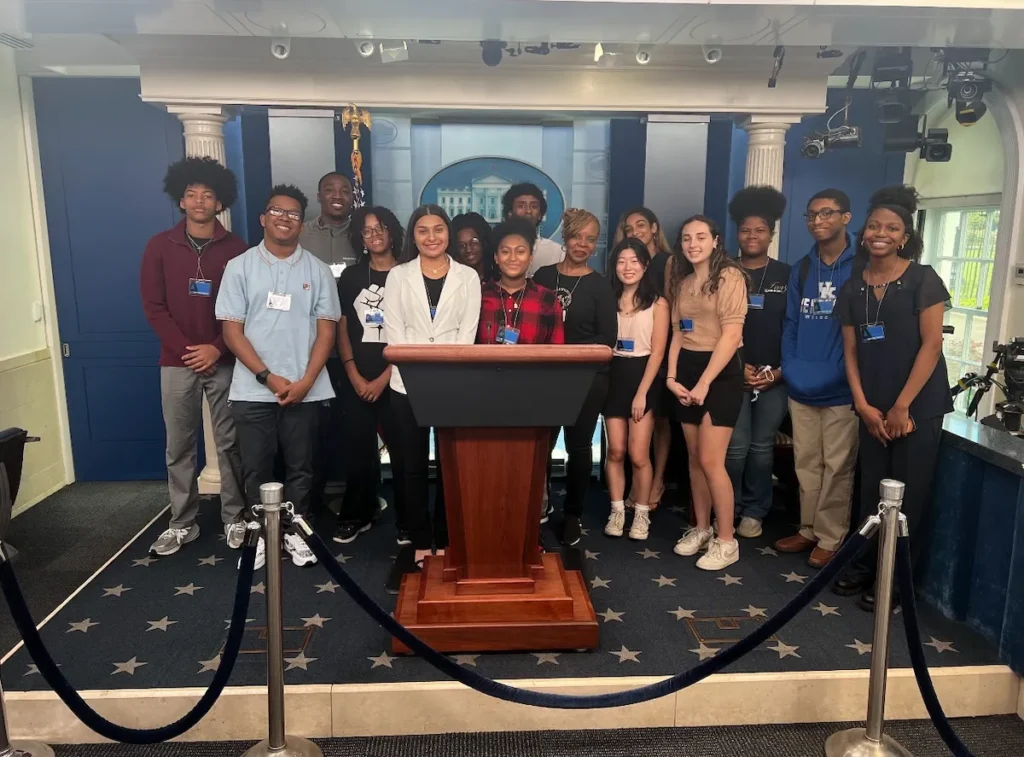
Earlier this month, Lewis and other journalists greeted nearly three dozen D.C. area high schoolers—including the child of an Urban Journalism Workshop alumna— who attended their first session of the spring at American University School of Communication.
Lewis said the overwhelming interest in journalism provides a sense of relief for those concerned about the future of journalism.
“It shows that young people are interested in journalism, in a way where it’s our imperative as mid-career senior journalists to help them come up and learn from us,” Lewis told The Informer. “We need to focus on mentoring more in the spirit of Black Press [because] our community is how we help uplift one another.”
Lewis noted the more than 250 other Black-owned publications under the National Newspaper Publishers Association (NNPA), has and will continue to weather a storm brought on by the extinction of the classifieds section, and exacerbated by stagnant wages and an emphasis on reader engagement rather than quality content.
“When the mainstream media catches a cold, the Black Press has a fever, but we’ve been around due to our community support,” Lewis told The Informer, albeit with a caveat. “The support is invaluable, but it’s true too to say that Black newsrooms are underresourced and that could be a challenge when recruiting and retaining talent.”
Black Journalism Students Speak
In the decades following the emancipation of enslaved Black people, African American-owned publications spurred the Great Migration of the early 20th century. These newspapers also acted as institutions that propelled the fight for school integration, positive Black media portrayal and representation, and mainstream America’s appreciation for African Americans’ contributions.
The Black Press has since faced challenges in the post-civil rights era, especially as Black journalists left Black-owned publications for the supposed greener pastures of the mainstream press. While many news outlets crumbled under the financial pressure, several others that are still in existence often capitulate to moderate, corporate forces that have taken the place of traditionally grassroots funding sources.
While he hadn’t known much about it before college, HU journalism student Amen Debretsion has learned about the history of the Black Press in his multicultural media history course. Through the coursework, he has discovered journalists, like Ida B. Wells, who’ve served as models for how to authentically depict the U.S. Black experience.
“I didn’t know journalism had such a big impact on the… development of African-American communities,” said Debretsion, an Oakland resident of Ethiopian descent who’s in his sophomore year at Howard. “Learning about the Black Press really helped me and solidified for me that I have a place in journalism. I can really make an impact.”
As Debretsion recounted, he decided to pursue journalism in high school after watching “The Fourth Estate,” a documentary about The New York Times’ coverage of the first Trump administration. Since enrolling at Howard, Debretsion has joined The Hilltop, where he pens investigative pieces.
He called the experience of writing for an award-winning college newspaper preparation for his ultimate professional goal.
“I want to make an impact [by] making sure that people’s stories don’t go under the radar or some government agenda or journalism institutions twist people’s stories to make it fit the government’s agenda,” Debretsion told The Informer. “I just want to make sure that people’s voices are heard.”
Debretsion said he’s open to carrying out that mission at a Black Press publication.
“I learned a lot more about the power of the Black Press and I feel like [joining a Black-owned newspaper] would just be a better way for me to learn more about our history,” Debretsion told The Informer. “It would be the right place for me to be to make sure I make that change.”
Aniyah Genama, copy-editor and reporter at The Hilltop, said that her involvement in the Black student press has helped her develop a more culturally conscious perspective as a writer.
“We are held to a very, very high standard at The Hilltop and people are expecting you to come from a Black angle, so that causes you to dig deeper as a Black person and see how these events connect to what we’re going through or what we did go through as a people,” Genama told The Informer. “I think it’s a legacy and responsibility to always keep in mind how this affects Black people and making sure that that connection is clear.”
More than 21 miles north along Baltimore-Washington Parkway, Jayden Ford, co-editor in chief of Spectrum Newspaper at Bowie State University, is using her platform to keep students in the know about how a second Trump presidency will affect their academic careers.
“There were so many people on campus who were fearful that FAFSA was going to be shut down,” Ford said. “Is it going to happen in the future? We don’t know, but a lot of information is going to be out there and it’s a duty for us to let students know what’s going to impact them so people aren’t in a state of fear at all times.”
In the era where misinformation is increasingly circulating, many young Black journalists like Ford said they feel a sense of responsibility to deliver accurate, honest and culturally relevant news.
“It feels like we’re fighting a war on journalism: there are so many different sources and stories that are being claimed as fake news and being unreliable,” Ford said. “Having a Black Press that Black people are able to rely on, with people who are in their community, has a trust factor that you wouldn’t necessarily get from other publications.”
Black student journalists at primarily white institutions are also working to inform their communities, all the while battling for resources and recognition from their white counterparts.
That’s certainly the case at University of Maryland (UMD) College Park, where the Black student paper, The Black Explosion continues to be a valuable source for information for UMD’s Black student population more than 50 years after its founding.
“Our campus is huge and our Black population here is not small, but the population of Black journalists is small, and that is our audience. They are looking for people that represent them in ways that they can trust.” said Hailey Closson, a staff writer for The Black Explosion and DEI coordinator for The Diamondback, UMD’s main campus student newspaper. “We do need to get those stories out about campus communities. Everything that’s happening isn’t just politics, it’s affecting very real people. The people that are on campus need attention paid to them and we are the people that are going to do it.”
As the Trump administration continues to target DEI initiatives and student political expression, other students, like Jade Tran, who serves as diversion editor for The Diamondback and freelancer for The Black Explosion, said she hopes to combine reporting with elements of activism and pursue further opportunities within Black media.
“I think we’re just in a unique position, especially within this presidency, to be able to speak up about things from a perspective of being affected, and I think getting involved with the Black press is a really good way to have an outlet to do so and reach people.” Tran said. “I would love to be part of something like that and speak freely, but also factually.”
Read the story on The Washington Informer.